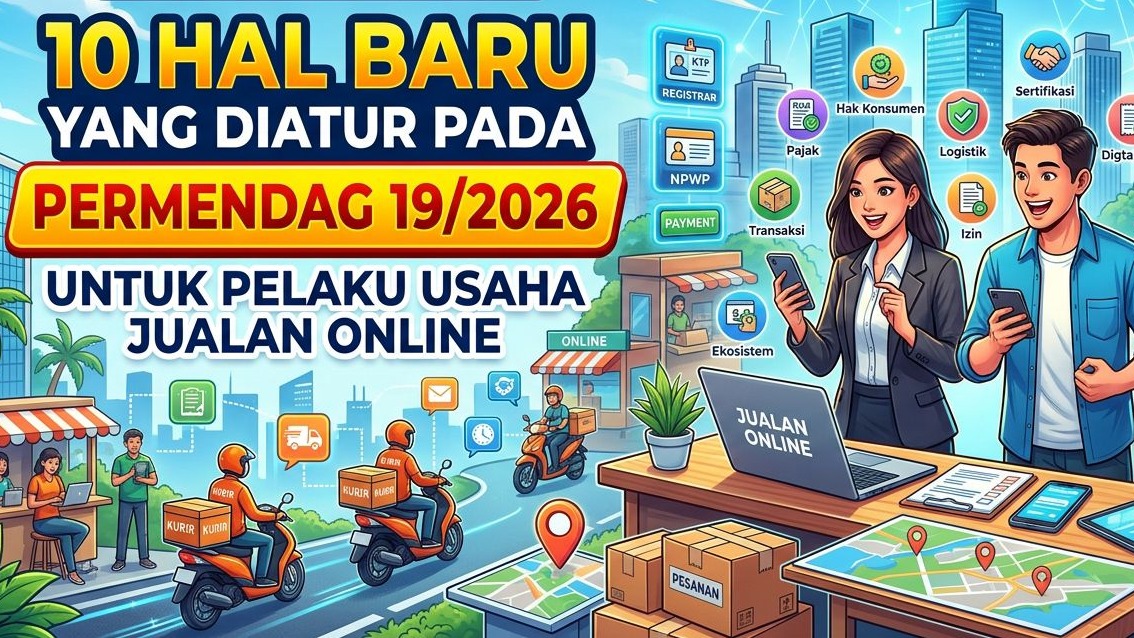
Ministry of Trade Regulation No. 19 of 2026 takes effect on June 8, 2026, and repeals and replaces Ministry of Trade Regulation No. 31 of 2023. This new regulation not only addresses marketplaces but also expands regulations to cover various digital business models and introduces new provisions regarding platform transparency, domestic products, the use of artificial intelligence (AI), and the protection of merchants and consumers.
This raises the question:
What has changed, and what steps should businesses take?
1. Online Businesses Must Be Legally Registered
This is perhaps the most fundamental point. Article 4 of Ministry of Trade Regulation No. 19/2026 stipulates the business licensing requirement for business operators engaged in PMSE activities. For domestic merchants, the business license must at a minimum consist of a Business Identification Number (NIB) in accordance with applicable laws and regulations. The obligations do not stop with the merchants. Online Marketplaces (PPMSE) that provide a platform for domestic merchants also have an obligation to ensure compliance with these legal requirements. PPMSE platforms are even required to reject registrations from merchants who do not meet the licensing requirements as specified in the regulations. Thus, simply having a marketplace account is no longer sufficient to demonstrate that a person can legally conduct business activities. A marketplace is a platform for trading; the NIB is an integral part of the business’s legal compliance.
Transition Period: However, the government has provided a grace period. Article 17 establishes a mechanism for merchants who are still in the process of obtaining legal compliance through the status “In the Process of Legalization.” New merchants are given a maximum of 6 months to meet licensing requirements. If these requirements are not met, the PPMSE is required to restrict the merchant’s access, including suspending transactions. Meanwhile, for merchants who were already operating before Ministry of Trade Regulation No. 19/2026 took effect, Article 74 grants an adjustment period of up to 18 months to fulfill their licensing obligations. This means that existing sellers do not have to stop selling immediately on the day the regulation takes effect but are given time to complete the legalization process.
2. Increasingly Regulated Digital Business Models
Ministry of Trade Regulation No. 19/2026 no longer focuses solely on marketplaces. Article 3 expands the regulated business models for PPMSE to eight forms, namely:
Online retail;
Marketplace;
Online classified ads;
Price comparison platform;
Daily deals;
Social commerce;
Ride-hailing; and
Online travel agency.
The last two models represent an expansion of the previous regulations. This change is important because digital commerce today is no longer limited to “online stores.” A single app can serve as a platform where people order food, transportation, hotels, tickets, goods, and services—all while making transactions. Ministry of Trade Regulation No. 19/2026 aims to ensure that the development of such business models continues to have legal certainty.
3. Merchants Must Be More Transparent About the Items They Sell
Article 15 imposes a particularly relevant obligation on marketplace sellers. Sellers are required to provide information regarding the origin of goods and evidence of compliance with standards for goods and/or services. Such information may include, among other things:
product registration number or SNI certificate;
a halal certificate, if required;
registration numbers related to security, safety, health, and the environment;
licensing or registration of pharmaceutical and food products;
origin of the goods—whether they are domestically or foreign-produced;
the trader's country of origin; and
country of origin for shipments originating from abroad.
Interestingly, this obligation is not imposed solely on sellers. Article 15(2) requires PPMSE to provide a feature for submitting and displaying such information. Thus, the responsibility is shared between sellers, who provide the information, and the platform, which provides the means for transparency.
4. The “Official Store” Label Shouldn’t Be Applied Haphazardly
Have you ever seen labels such as “Official Store,” “Authorized Store,” “Flagship Store,” or other credibility labels on marketplaces? Now, such labels are also receiving special attention from regulators. Article 16 governs the granting of certain labels or descriptions to merchants by the PPMSE. If such a label indicates an official relationship with a brand owner, manufacturer, distributor, or specific party, there must be a basis or evidence to support that relationship. The PPMSE also has an obligation to verify and ensure that the labels provided do not mislead consumers. Merchants are responsible for the accuracy of the documents they submit to the platform.
Meaning: Do not use the term “Official” if the official relationship cannot be proven. For consumers, this label is not merely decorative. It can serve as the basis for consumer trust when making purchasing decisions.
5. Marketplace Fees Must Be More Transparent
One issue that sellers frequently face is changes in platform fees. For example, a fee might be a certain percentage today, only to change a few months later. Sellers often only become aware of these changes once a transaction has already taken place. Ministry of Trade Regulation No. 19/2026 provides clearer protection. Article 14(1) stipulates that fees charged to merchants must be communicated transparently and in language that is easy to understand. Furthermore, Article 14, paragraphs (2) and (3), require that these fees be set forth in a written agreement and/or an electronic contract that can be downloaded by the parties. If there are changes to fees, penalties, or other commercial terms, such changes must be communicated to merchants and included in an updated agreement. Equally important, Article 14(5) grants merchants the right to file a written objection to specific changes. PPMSE is then required to provide a response within 14 business days at the latest, as stipulated in Article 14(6). This is a significant change in the legal relationship between the platform and merchants. The platform is no longer merely the owner of a “digital storefront”; its commercial relationship with merchants must also be managed transparently.
6. Domestic Products Should Be Given Priority
Ministry of Trade Regulation No. 19/2026 also demonstrates a strong commitment to domestic products and SMEs.
Article 37, among other things, governs support for domestically produced goods and the aggregation of goods.
Furthermore, Article 40 is one of the most interesting provisions because it regulates the visibility of domestically produced goods in digital systems.
Certain PPMSEs are required to prioritize domestic products in their search, recommendation, and ranking systems. These products must be given priority to appear at the top of the results, including in the first row of the first page, in accordance with the regulations.
In other words, the “Buy Local” policy goes beyond simply providing promotional pages.
Local products must also gain visibility in the platform’s search and recommendation mechanisms.
However, it is important to understand that these regulations do not mean the government determines the code or algorithmic formula for each marketplace. What is regulated are the performance requirements and governance; the government does not write the platforms’ algorithms.
7. MSME Sellers Can Receive Incentives from the Platform
Support for MSMEs goes beyond mere visibility. Ministry of Trade Regulation No. 19/2026 provides for support in the form of promotional programs and certain incentives for micro and small businesses that sell domestically produced goods. These incentives may include discounts on promotional costs, advertising costs, or other forms of incentives in accordance with the platform’s terms and conditions.
However, there are requirements that must be taken into account, particularly regarding MSME status and domestically produced goods. Thus, for MSMEs, the NIB is not merely a matter of legal compliance. Legal compliance can also serve as a gateway to accessing various benefits within the digital commerce ecosystem.
8. Social Commerce Cannot Operate as Freely as a Marketplace
Ministry of Trade Regulation No. 19/2026 also establishes a clearer distinction between social-commerce and marketplace business models. Article 25 sets forth provisions regarding social-commerce, including a prohibition on such business models from engaging in certain activities that would essentially classify them as marketplaces. One such activity relates to facilitating payment transactions within the platform. Social-commerce is also restricted from acting as a producer within the context defined by the regulation. This provision is important because the growth of social-commerce has blurred the lines between social media, promotion, and commerce. Regulators must ultimately determine: When is a platform still a social media platform, and when has it become a commerce operator?
9. Imported Goods Sold Directly to Indonesian Consumers Are Subject to Price Caps
Cross-border trade is also subject to further regulations. Article 23(2) sets a minimum value threshold for foreign goods sold directly to consumers in Indonesia through cross-border e-commerce platforms, namely FOB USD 100 per unit in accordance with applicable regulations. This provision is part of a policy aimed at creating a more balanced competitive environment between foreign and domestic products. Consequently, businesses operating cross-border e-commerce models must comply with this minimum price requirement, in addition to legal requirements and product standards.
10. AI Is Now Also a Compliance Issue
This may be one of the most “2026”-specific provisions. Ministry of Trade Regulation No. 19/2026, for the first time, specifically regulates the use of Artificial Intelligence (AI) in electronic commerce. The provisions are contained in Article 47. Article 47(1) stipulates that business entities utilizing AI in electronic commerce (PMSE) remain responsible for the use of such technology. Furthermore, Article 47(2) mandates the obligation to provide information and/or labeling to consumers when goods, services, information, recommendations, promotions, or marketing utilize AI. In other words: AI may generate content, but it does not assume legal liability.
Specifically for PPMSEs, there are additional obligations regarding the governance of AI use based on risk level, as well as complaint and correction mechanisms. Article 47(4) also emphasizes that ethical considerations, governance, personal data protection, consumer protection, fair competition, and intellectual property rights in the use of AI must still comply with applicable laws and regulations. This means that using AI to create advertisements does not mean that a business operator can say, “The AI created it, not me.” Legally, the responsibility still lies with the business operator.
So, What Should Business Owners Do?
Ministry of Trade Regulation No. 19/2026 ultimately changed the way businesses view digital commerce activities.
For merchants/sellers, there are at least a few things that need to be checked immediately:
1. Check the NIB and KBLI
Make sure your business has an NIB and that the business activities listed on it match the business you are actually operating.
2. Check the product information
Ensure that information regarding the origin of the goods, SNI certification, halal certification, distribution permits, registration, and other standards is available if required.
3. Check marketing claims
Do not use terms such as “official,” “authorized,” “100% original,” “lowest price,” or other similar claims carelessly if you do not have verifiable evidence to support them.
4. Review the contract with the platform
Sellers need to be aware of service fees, commissions, penalties, fee adjustment mechanisms, and their right to file a complaint.
5. Check for AI usage
When using AI to create promotional materials, recommendations, product information, or marketing content, ensure that disclosure and labeling requirements are met.
6. For the platform, review the algorithms and governance
PPMSE needs to evaluate search systems, recommendations, rankings, promotions, the use of user data, and mechanisms to protect against unfair business practices.